






About this project
Project Background
The DriveFit 2.0 initiative builds upon the success of the original DriveFit intervention, an acclaimed pre-driver education intervention that garnered recognition for its innovative approach to improving road safety among young and novice drivers. This initiative was developed as part of the Pre-driver Theatre and Workshop Education Research (PdTWER) project.
With road traffic injuries being a leading cause of death among 5–29-year-olds globally, and young drivers in Great Britain representing a significant portion of serious road incidents, the need for impactful educational interventions has never been more critical.
Project Purpose
DriveFit 2.0 is dedicated to advancing road safety education for young road users in Great Britain and addresses the critical issue of the disproportionate involvement of 17-24-year-olds in road collisions and incidents in Great Britain.
Traditional road safety education methods have fallen short in effectively engaging and educating this at-risk demographic. This programme of research redesigns the DriveFit intervention for easier delivery, evaluates its impact with our Fire and Rescue Service partners, and will share programme findings to improve road safety education nationwide.
Project aim and approach
The primary goal is to redesign and enhance the DriveFit road safety intervention to improve the attitudes and intentions of pre-drivers, ultimately contributing to a reduction in road collisions and incidents among this demographic. The approach involves:
- Redesigning the DriveFit intervention to facilitate easier delivery within school and college settings, incorporating active learning components alongside the original film content.
- Conducting a small-scale effectiveness and process evaluation with the support of two Fire and Rescue Services, to measure the intervention’s impact on students’ attitudes and intentions.
- Disseminating the findings to key stakeholders in road safety, enabling informed decision-making and broader adoption of effective road safety interventions.
Project Timescales
The DriveFit 2.0 project is structured over a 17-month period, commencing in February 2024 and concluding in July 2025. The initial phase focuses on the redesign and adaptation of the DriveFit intervention, followed by a pilot phase in select schools and colleges. The evaluation period, involving pre- and post-intervention assessments, will span several months to ensure comprehensive data collection and analysis. The final phase will concentrate on the dissemination of findings and the preparation of resources for broader implementation.
Project partners & funding
DriveFit 2.0 is made possible through the funding, collaboration and support of various partners, including the Road Safety Trust, National Fire Chiefs Council, Road Safety GB, Surrey Fire and Rescue Service and Devon and Somerset Fire and Rescue Service. Educational institutions and local authorities across the UK are also key partners, facilitating the implementation of the program.
Latest project updates
January 2026
The final report of the DriveFit 2.0 trial and evaluation has been published.
The evaluation found that DriveFit 2.0 is feasible to deliver as a teacher-led, curriculum-embedded programme and acceptable to students, with lessons rated as credible, useful, and moderately engaging. Emotional responses were neutral to moderate rather than fear-inducing, aligning with best practice in PSHE and behaviour change. The programme adopts a strengths-based approach, focusing on skills, judgement, and practical strategies rather than fear-based messaging. In terms of outcomes:
- No significant short-term effects were found for attitudes, intentions, or self-efficacy related to mobile phone use, fatigue, or speeding once baseline levels and trends in the comparison group were taken into account.
- A small but statistically significant increase in perceived risk was observed among intervention students, suggesting a modest improvement in risk appraisal.
Students entered the programme with already risk-averse baseline attitudes, which limited the scope for detectable short-term change. While several outcomes trended in a more safety-supportive direction among intervention students, these changes were not statistically distinct from the comparison group once baseline differences were controlled. Importantly, the intervention group was predominantly male, a group that typically reports lower risk perception and is often less responsive to education-based road safety programmes. The observed increase in perceived risk within this cohort is therefore a noteworthy and encouraging finding.
The findings highlight a central tension for road safety education policy: teacher-led delivery supports scalability and sustainability, but may be associated with weaker short-term effects than more intensive, professionally facilitated models. Crucially, the study demonstrates the value of controlled evaluation in applied education settings. Without a comparison group, several of the directional improvements observed among intervention students could easily have been interpreted as evidence of effectiveness. The controlled design shows that such trends must be interpreted cautiously, reinforcing the importance of robust evaluation in informing policy and investment decisions.
The findings point to:
- the importance of delivery mode and facilitation intensity,
- the need for realistic expectations about what pre-driver education can achieve in the short term, particularly where reported baseline risk aversion is already high,
- the value of evaluation designs that clearly distinguish feasibility, acceptability, and effectiveness, to avoid over- or under-interpreting early or partial signals of change.
The study also illustrates the practical challenges of conducting real-world trials in schools and colleges, including variability in delivery and the absence of systematic fidelity monitoring across all settings, an understanding of which is critical for building a credible evidence base.
The DriveFit programme and resources can be accessed via Road Safety GB and drivefit.info. They can also be accessed via the links below:
- DriveFit 2.0 teachers guide
- Lesson 1: Presentation & Lesson plan
- Lesson 2: Presentation & Lesson plan
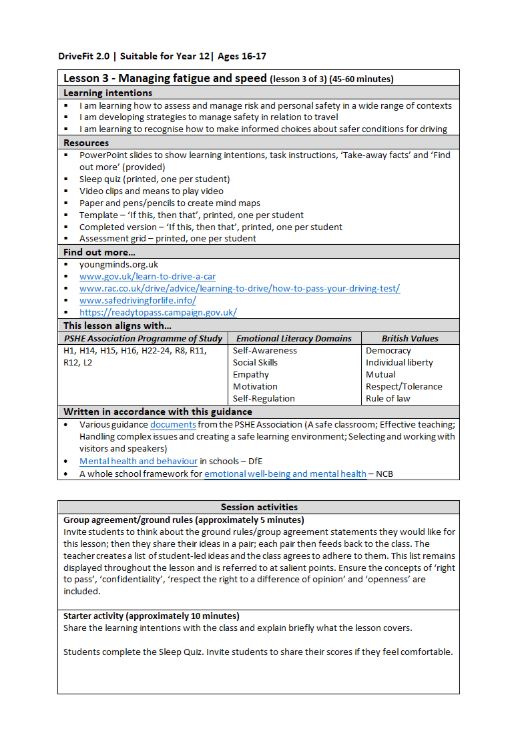
- Lesson 3: Presentation & Lesson plan
March 2024
A promotional film outlining the DriveFit 2.0 project has been released:
To find out more see the following press notice.